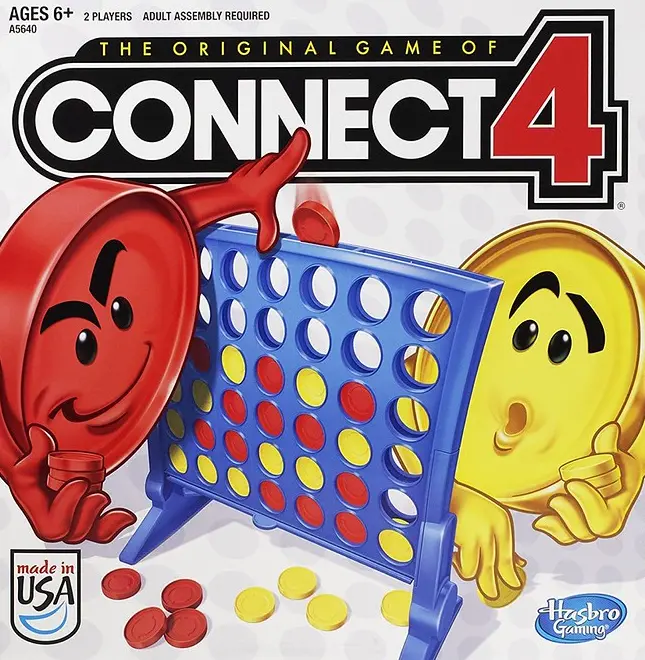
Writing my memoir, Where Did My Brain Go?, changed my life.
The book inspired me to participate in a drug-free traumatic brain injury study.
Part of the study requires a researcher to watch me play Connect Four online and record my scores.
At first, I lost every game.
Then I started analyzing my mistakes. I learned strategies. I developed a system.
Now I win a few games.
You can too.
Why Connect Four for Brain Therapy?
Cognitive Development Through Play
Cognitive development means the brain learning new skills and getting better at thinking tasks.
Connect Four helps your brain practice several important skills at the same time.
When you play Connect Four, your brain must do several things at once.
You must remember where the pieces are on the board. This exercises your working memory.
You must plan your next move and think about what your opponent might do. This exercises your planning ability.
You must stop yourself from moving too quickly without checking the board. This exercises your impulse control.
You must switch between offense and defense. This exercises your mental flexibility.
Why Researchers Choose Connect Four
Researchers and therapists use Connect Four because it is simple to learn but hard to master.
The rules are easy. Anyone can understand them in one minute.
But winning requires the exact skills that traumatic brain injury often damages.
This makes Connect Four perfect for measuring progress and exercising damaged brain pathways.
Everybody Likes Connect Four!
Connect Four: A Brief History
Connect Four was created in 1974 by Howard Wexler and Ned Strongin. Milton Bradley released it commercially as a game where two players drop colored discs into a vertical grid.
Connect Four is unique. Most board games use a flat, horizontal surface. Connect Four stands upright. This vertical design makes the game special.
The game is 51 years old and still popular around the world.
The goal is simple. Get four of your discs in a row. Horizontal, vertical, or diagonal.
The first player to connect four wins.
Connect Four seems simple. But it is not a game of chance.
In 1988, mathematician Victor Allis proved that Connect Four is a solved game. This means the first player always wins, if they do not make a mistake.
The game is based on combinatorial game theory. A combinatorial game ends when a condition is solved. In Connect Four, it means that one player connected four playing pieces.
Every position on the board creates new possibilities. There are approximately 4.5 trillion possible game situations in Connect Four. Every move matters.
The Mathematics
A standard Connect Four board has 7 columns and 6 rows. That creates 42 spaces on the board.
But you do not need to memorize all the possible moves. You need to understand patterns. You need to think one move ahead.
Most importantly, you need to check the board before you move.
Why I Lost So Many Games
My Biggest Mistake
I lost many games by not checking my opponent's position before I moved.
My brain would hyper focus on building my own winning line. Everything else disappeared. The rest of the board did not exist.
Then anxiety would flood in. What if my scores do not improve? What if the researcher thinks I am getting worse? What if this study cannot help me?
The testing environment creates its own excitement. Someone is watching. Someone is recording. This matters.
My 71-year-old brain with no impulse control would fire the move before I finished thinking. The disc would drop. My opponent would win.
External distractions are not the problem. The researcher makes me wear headphones. My phone is off. The room is quiet.
The problem is internal. My own thoughts sabotage me. Hyper focus. Anxiety. Impulse control failure. Insomnia that leaves me exhausted and unable to concentrate.
People with traumatic brain injury often struggle with impulse control. Our brains want to act immediately.
We see an opportunity and we take it. We do not pause. We do not check.
Hyper focus makes it worse. When TBI hyper focus kicks in, the world narrows to a single point. Everything else vanishes.
This combination loses games. Outside the study, it ruins much more.
The Board Scanning System
🔍 Count to 4 Before You Move
1. Can my opponent win on their next turn?
Look at every column. Count their discs in each row, column, and diagonal. If they have three in a row with an empty space, you MUST block them.
2. Can I win on this turn?
Look for your own winning moves. Do you have three in a row with an empty space? If yes, take the win.
3. Will my move create a win for my opponent?
This is the hardest check. Imagine placing your disc. Will your opponent be able to use your disc to win? Look at the position ABOVE where you plan to move.
4. Does my move improve my position?
After checking for dangers, make sure your move helps you. Build toward the center. Create multiple threats. Force your opponent to respond to you.
Take Your Time
Counting to 4 takes practice. At first, it will feel slow. You might think you are taking too long.
You are not. Most Connect Four games allow plenty of time between moves.
Count to 4 out loud before you place your disc. Use that time to scan the board.
Winning slowly is lots more fun than losing quickly!
Print the Four Steps
Keep a printed checklist next to your computer when you play.
The checklist has large fonts so you can read it without changing your glasses.
On Mac: Click Print, then choose "Save as PDF" to save without printing.
Winning Strategies for First Player
You Move First: Control the Center
The first move should be in the center column. Column 4 if you count from the left.
Starting in column 1 or column 7 almost always causes a loss.
The center column connects to the most possible winning combinations.
From the center, you can build horizontal, vertical, or diagonal lines in multiple directions.
After your first move in the center, continue building near the middle of the board.
Try to create two threats at once. This is called a fork. Your opponent can only block one threat. You win with the other.
Good First Player Moves
Start in column 4. Build near the center. Create diagonal threats. Force your opponent to respond to you.
Weak First Player Moves
Starting in columns 1 or 7. Ignoring the center. Building only vertically. Not checking opponent threats.
Winning Strategies for Second Player
You Move Second: Block and Counter
The second player cannot force a win with perfect opponent play. But most opponents are not perfect.
Your job is to block their center control. Force them to make mistakes. Wait for your opportunity.
If your opponent starts in the center column, play in column 3 or column 5. Stay close to the center.
Do not let them dominate the middle of the board.
Watch for their patterns. Are they building horizontally? Diagonally? Block their strongest line.
Then build your own threats. Eventually, they will make a mistake. They will fail to block you.
You will win! Hurray!
The Waiting Game
As second player, patience is your weapon. You cannot rush to victory.
Focus on defense first. Block their threats. Then slowly build your own position.
When they make a mistake, you will be ready.
Building Your Confidence
You Can Win
Connect Four is not about having a perfect memory. It is not about making split-second decisions.
It is about following a system. It is about checking the board before you move.
Even with a traumatic brain injury, you can learn these strategies. You can win games.
I did. You can too.
Every player loses games. Professional chess players lose. Professional poker players lose. Connect Four players lose.
Losing does not mean you failed. Losing means you learned something.
Measuring Progress
I rarely won a game when I started. But now, as I learn to count to 4 before I move, my record is improving.
I do not expect to be perfect, like Victor Allis. But it is gratifying to win more games.
You can improve too.
When You Lose a Game
Learn From Losses
After you lose, think about what happened. Did you miss an opponent threat? Did you move too quickly?
Do not get angry at yourself. Do not feel depressed.
Brain injury makes some things harder.
The goal is not to win every game. The goal is to get better over time.
I still lose games. Sometimes I forget to count to 4. Sometimes I move too fast.
The Psychology of Winning
Your Brain Can Learn
Traumatic brain injury changes your brain. But your brain can still learn new patterns.
Your brain gets stronger every time you count to 4.
Every time you slow down and scan the board, you practice impulse control.
This is not just about winning at Connect Four. This is about retraining your brain.
Neuroplasticity is the most amazing brain activity.
Your brain changed after your injury. Your brain can use neuroplasticity to change again, from playing Connect Four!
Games like Connect Four are not just entertainment. They are therapy.
Becoming a Connect Four Expert
The Ultimate Reference Book
If you want to master Connect Four completely, there is one book that stands above all others.
The Complete Book of CONNECT 4: History, Strategy, Puzzles by James D. Allen is the definitive guide to the game.
This book recounts the history of Connect Four. It offers game-enhancing strategies from a puzzle expert.
The book provides actual examples so you can test yourself on what you learned.
By the time you finish this complete guide, you will be a lean, mean, disc-dropping machine. You will be ready for Connect Four success.
Where to Find the Book
You can borrow this book from the Internet Archive at archive.org.
Note: You need to register for a free account to borrow books from the Internet Archive.
Full disclosure: I have not read this book yet. But I added it to my 2026 New Year's resolutions.
Final Thoughts
You picked up this guide because you want to improve. That means you are already on the right path.
Remember to count to 4. Take your time. Scan the board.
Win or lose, you are exercising your brain. You are participating in your own recovery.
That is something to be proud of.
Never give up!
Practice Resources
You can play Connect Four online for free at many websites. I like 4 in a Line! and Straight 4.
Start with easy levels. Practice counting to 4 until it becomes automatic.
Then move to harder levels. Track your progress. Celebrate your wins.